My Half Price Ride - Buying It
Cars are expensive. You have to buy them, fuel them, maintain them, and buy insurance.
The average American spends $12000 a year on a car. That’s $120,000 over 10 years. I was doing better. My van was costing me $7600 a year - $2700 in gas, $4K in repairs, $700 in insurance, $200 in registration, plus depreciation.
My new car costs $5700 a year. Here’s how I did it.
The first step was to decide to act. My 2007 Toyota Sienna was supremely useful, but the 15-year-old vehicle was getting expensive. Repair costs, $3-5K/year, and bad fuel economy, 20 miles per gallon, were adding up.
I had just moved into an area without good transit, bike lanes, or sidewalks. I had a longer commute and needed a better vehicular appliance car. If my neighborhood had better weather, dense housing, and good bike lanes, I would have purchased an electric cargo bike.
Thus, in the midst of a “the worst time to buy a car”, I…bought a car. A vehicle is the 2nd biggest purchase most folks make, and I was determined to do this right.

1. Know Thyself
To start, I kept my goal clear and focused. I wanted the most economical car that meets my needs.
I’m frugal: I focus on value per dollar.
Cost is money spent.
Value is personal, harder to define, and depends on your priorities. I sorted car-related features into three categories: “must have”, “nice to have”, “don’t care about”
Must Haves
- Reliable
- Avoid vehicles that have chronic issues, like wet-belt Ford Ecoboost engines or Nissan CVT transmissions.
- Safe
- Hard to steal. No Kia Boyz cars for me.
- Enough storage space. It must fit the musical instruments I use to teach.
- Good speakers and Bluetooth connectivity.
- Cruise control for road trips
- 400 mile range per day for road trips.
- A good maintenance record if it’s not a new car.
Tip 1 - Keep your ‘Must Have’ list small
Nice to Have
- Apple CarPlay
- Intuitive to drive
- Simple mechanical design. Simple = less to break.
- No accidents. It’s hard to tell if a car that was in an accident was properly repaired.
Don’t Care About
- Exterior color
- Interior color
- 4 wheel drive
- Offroading capability
- Lots of speed. 0-60 times
- Lots of power
- Self-driving anything. Level 5 driving capabilities don’t exist, and Level 2/3 systems don’t suit human psychology.
- Leather seats
- Stylishness. A car is a box that moves me from point A to B.
- An upright seating position
- Fancy electronic features
- Sunroof/moonroof. They’re nice, but they can lead to leaks.
- More space than needed for the basics.
- Bigger wheels/tires
2. Goals & Options
My next step was to identify the makes and models of cars that would meet these goals. I used a simple criteria to identify options:
- Gets better than 30 miles per gallon. The cost of fuel adds up.
- A Dashboard Light ‘Reliability Score’ of 70+
- Still being made as of 2016. I didn’t want to pay over and over for expensive fixes on older cars.
I found 13 options:
| Model | Reliability | Mpg |
|---|---|---|
| Toyota Prius | 99 | 52 |
| Toyota Prius Prime | 99 | 54-133 |
| Toyota Yaris | 99 | 35 |
| Toyota Venza | 95 | 39 |
| Honda Fit | 92 | 36 |
| Toyota Avalon Hybrid | 91 | 43 |
| Mazda 2 | 89 | 35 |
| Toyota Corolla | 86 | 34 |
| Toyota Corolla Cross Hybrid | 86 | 42 |
| Toyota Camry Hybrid | 85 | 52 |
| Honda Insight | 81 | 52 |
| Toyota RAV4 Hybrid | 80 | 40 |
| Mazda 3 | 70 | 31 |

Then I went to 6 auto shops and asked their senior mechanics to chat about cars over a beer. I asked which cars only need basic maintenance, and which cars they’d recommend to family. I heard many of the same answers. When in doubt, ask experts.
Tip 2 - Get the smallest car you can
I had defined value. Let’s look at cost.
3. Cost & Metrics
“You Manage What You Measure” ~ mangled quote originally by Lord Kevlin.
How much something costs depends on what you measure. Don’t ignore costs - they won’t ignore you.
My goal was a “vehicular appliance for as cheap as possible”, so I chose a single metric: the 10-year Total Cost of Ownership (‘TCO’). That’s the cost to buy the car, and the cost of insurance, repairs, fuel, and registration over 10 years. I chose 10 years because I will keep my car for a long time.
To pay less for a car, I included all the costs of owning one:
- Buying the car
- Fuel (gas, electricity)
- Repairs / Maintenance
- Car insurance
- Parking
- Registration
Tip 3 - Ask your insurance how much it costs to insure different makes/model
I’m a data guy, so I made a spreadsheet, showing a rough ‘10 Year TCO’ for all of the cars on my list, plus the most popular vehicles in the US.
You can see there’s a huge range of costs. Some things make cars cheaper: a small size, hybrids, and manufacturers with a history of making reliable cars (Toyota, Honda).
Now I needed to narrow down my options.
4: Winnowing
I went to car dealerships and test drove the cars, to create a shortlist of 1-4 car models. This was the first time I’d interacted with dealerships in this process. It had been only research thus far.
- Some cars are too small. So, no Mazda 2, Mazda 3, Toyota Corolla, or Toyota Yaris
- Some car designs won’t fit the instruments I need to move. So, no Toyota Corolla, Camry Hybrid, Avalon Hybrid, or Honda Insight.
- Some cars are too new, meaning there aren’t good used deals. So, no Toyota Corolla Cross Hybrid.
- SUVs are bigger than I need. I won’t pay extra for that. So, no Toyota RAV4 Hybrid, Venza, or Honda CR-V. My parents drove sedans and did just fine.
- Design matters a lot for a small car. A Honda Fit works because its interior is flexible. It’s been deprecated, but recently enough that there are ‘young’ Fits for sale.
- The Toyota Prius and Prius Prime work due to their hatchback design.
That narrowed down my shortlist to 3:
- Toyota Prius
- Toyota Prius Prime
- Honda Fit
It was time to look at individual cars.
5: Individual Vehicles
I started with the spreadsheet I’d used for previous car purchases. I updated it with more features, such as:
- Calculating the MPG, reliability scores, repair costs, insurance costs, and onetime setup costs for each make, model, and year of car I’m looking at, in a ‘Model Lookup’ spreadsheet
- Adding variables to easily adjust the costs of fuel, electricity, the price of a replacement car, the miles I drive per year, and the relative importance of mileage vs age.
- Including the sales tax rate per city + county, to accurately calculate purchase price.
I looked at all of the Honda Fit, Toyota Prius, and Prius Primes for sale within 250 miles of home. A scatterplot shows the relationship between car purchase price and its 10 Year Total Cost of Ownership:
The graph is clear - a Toyota Prius or Prius Prime would be cheaper than a Honda Fit. The cars with the lowest 10 Year TCO are towards the bottom.
The Pandemic Crazy
It looked like people were impatient. New cars were selling for thousands over MSRP. 3-year-old used cars with 40K miles were selling at MSRP, as if they were a brand-new car. People were spending more than they because they wanted or needed a car right now.
The typical behavior of new cars rapidly depreciating wasn’t happening. Folks weren’t willing to wait a few months to buy a new car at MSRP.
Buy at MSRP
There’s a single dot below 55K at the bottom of the above graph - that was a new Toyota Prius, at MSRP.
I made my decision. I could wait 6 months for a new car. The cost differential of doing so, operating the van for 6 months, was $960, far less than the price/value difference of buying a used car at a premium. I would be patient.
Intermission
I ordered a new 2022 Toyota Prius at MSRP via Costco Auto. I waited 9 months and was finally told I wouldn’t receive one, because it was now 2023, and the new Prius was a different, and smaller, design.
Thus, I had to look at used cars once again.
6. Car Search 2, Electric Boogaloo
Then I realized I’d missed something: the Prius Prime calculations were wrong. Its fuel costs must be calculated differently, because they’re part gas, and part electricity. Driving a ‘Prime would cost $.08/mile in gas mode (50mpg, $4/gallon), but only $0.029/mile in electric mode (4.5 miles/kWh, $.13/kWh). Electric mode would be 2.7x cheaper than gas mode. Its fuel cost depends on how much the car is driven in electric mode.
Experiments with Google Maps suggested I could drive 55% of the time in electric mode on a typical day.
If I drove 15K miles a year, the fuel costs for each car would be:
- $808 for a Prius Prime ($540 gas, $268 electricity)
- $1200 for a Prius
- $1765 for a Fit
I updated my spreadsheet with the new fuel calculations. Lo and behold, Prius Primes were the best option.
Having added all local cars for sale, I knew what a good deal was. Every morning I checked used car listings (Autotrader, Craigslist and TrueCar) and updated my spreadsheet. I researched cars if they were in the top ten cheapest options by 10 Year TCO. I ignored the rest.
During my search, I noticed 2 things.
- Many cars from private sellers weren’t in great shape, with high mileage or a bad maintenance history.
- Most cars that were ‘great’ deals were rebuilt, meaning they had bad accident damage.
Dealership Negotiations

Finally, a good deal popped up at a dealership: $29.5K for a 2018 Prius Prime with 19K miles, with a 10-Year TCO of under $59K.
I went to the dealership, took the car for a test drive, and liked it. This was the first time in this process I’d really interacted with a car salesman. People dislike car dealerships because there is no transparency with pricing, and we don’t have many ways to learn to negotiate. Having done this before, I negotiated the price down to $28K. It helped that I had a spreadsheet showing ever other Prius Prime for sale in the state, so I could point out other good deals. Sales tax brought the price up to $30,940. I was careful to negotiate the “out the door” price, so they couldn’t nickel-and-dime me with random fees. We agreed on a price of $31,400 including sales tax, doc fee & registration.
I was carefully to tell them I’d buy the car only if it passed an independent mechanic’s pre-purchase inspection. NEVER buy a used car without one! My mechanic’s inspection found no major issues with the car. There was a tiny crack in a rear turn signal from a minor accident, not even enough to leak. Nothing epoxy can’t mend.
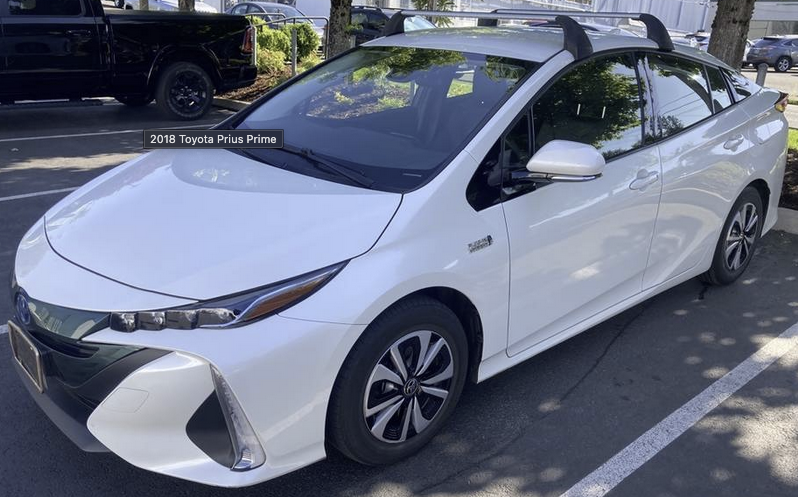
In the end, my ‘new’ car was a 2018 Toyota Prius Prime Premium with 19K miles on it.
7. The Results
I spent the next month outfitting the car for my needs:
- $132 for a pre-purchase inspection
- $31,400 to buy ($28K purchase price, $2850 sales tax, $550 registration+title fees)
- $500 for ceramic window tint, for privacy and cooling
- $462 for a catalytic converter shield. Hybrids are often targeted
- $290 for a roof rack, needed for long road trips
- $125 for a full-size spare tire ($55 for the wheel, $70 for the tire), for long road trips
- $117 for a front-and-rear dash camera and storage, to reduce the risk from accidents I didn’t cause
- $54 for car manuals via eBay
- $29 for a phone mount and long power cable
- $19 for a faux-leather steering wheel cover, to make driving more pleasant.
- $0 for superglue to repair the turn signal. I already had the glue. I tested it after I repaired to make sure the crack was truly sealed.
- $40 cleaning up my van: car washes, vacuuming, a lot of elbow grease
- -$8000 from selling the van
Total Spent: $33,128
My out-of-pocket cost to get the car was $25,168.
10 Year Costs
- Buying the Car - $33,128
- Fuel - $9028 ($3097 in electricity, $5931 in gas)
- Maintenance - $8854
- Insurance - $12,807
- Registration - $2613
- Selling the Car at the 10 Year Point - -$9400
- TOTAL - $57,030.
Return On Time
My van’s 10 Year TCO was over $90K, compared to the Prius’ $57K. Replacing my van is going to save me $33K. I spent about 80 hours doing this whole process, for a “savings” rate of $412/hour.
Coming Up Next
This was half the battle, getting a more economical car. The second half was next: owning it…
Published 01 November 2024